Overview
The AMD Versal adaptive SoC on the SC-OBC Module V1 contains different types of processors. Zephyr on the real-time processing unit (RPU) is the primary execution environment. The RPU runs regardless of whether an application uses Linux on the application processing unit (APU).
Applications can add the APU when they need Linux capabilities. When both processors are used, each runs its own software image and operating system, forming an asymmetric multiprocessing (AMP) system. The two sides can run independently or communicate explicitly when the application requires coordination or data exchange.
This page first explains the RPU and Zephyr baseline, then introduces the optional APU and Linux environment and the communication components used when the two sides exchange data.
When to Add the APU
The RPU and APU are suited to different workloads:
-
The RPU is designed for predictable execution of real-time workloads. Zephyr provides a small RTOS environment with deterministic scheduling. On the SC-OBC Module V1, the dual Cortex-R5F RPU operates in lockstep mode by default.
-
The APU provides the performance and memory-management features needed by Linux. Linux supplies networking, storage, device drivers, process isolation, and a rich application environment. However, its general-purpose scheduler and dynamic services make worst-case response times harder to bound.
The RPU and low-power peripherals reside in the low-power domain (LPD), while the APU resides in the full-power domain (FPD). The Safety Processor can control these power domains individually. This separation allows the RPU to continue real-time processing while the APU and FPD are powered down, reducing power consumption when Linux services are not required.
An application can run on the RPU without using the APU when Zephyr provides all required functions. When Linux services are needed, the application can add the APU and assign feature-rich services to Linux while keeping timing-sensitive or safety-related functions on Zephyr. The RPU and APU do not have to exchange data; they can operate independently when their workloads do not require coordination. When data crosses the boundary, it uses a defined communication mechanism such as RPMsg because the operating systems do not share an address space or processes.
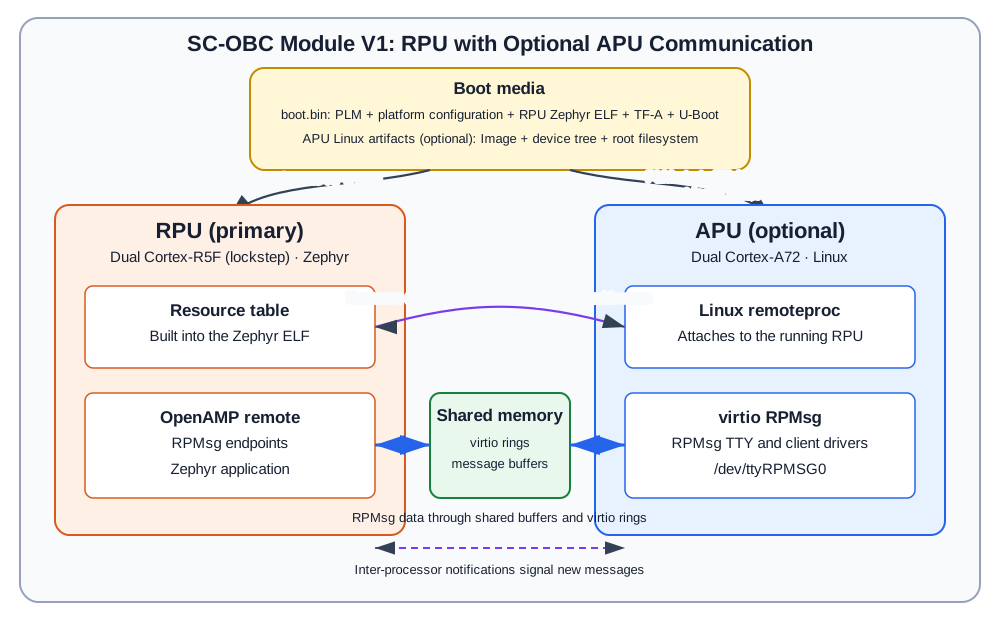
Communication Components
OpenAMP and RPMsg communication is optional. Applications that require coordination between Zephyr and Linux use the following components. Each description gives the general role first, followed by its use on the SC-OBC Module V1.
-
OpenAMP
-
General: An open-source framework that provides remoteproc and RPMsg components for RTOS and bare-metal environments. These components interoperate with the corresponding Linux kernel frameworks.
-
SC-OBC Module V1: Zephyr on the RPU uses the OpenAMP RPMsg and virtio implementation as the remote side. Linux on the APU uses its native kernel remoteproc and RPMsg frameworks as the host.
-
-
Resource table
-
General: A data structure included in remote firmware that declares resources and features needed by the host, such as memory carveouts, trace buffers, virtio devices, and vrings. Host remoteproc reads the table while booting or attaching to the remote firmware.
-
SC-OBC Module V1: The Zephyr ELF resource table declares one RPMsg virtio device and two vrings. During attach, Linux reads the table and assigns vring addresses from the regions reserved by the devicetree.
-
-
remoteproc-
General: A Linux kernel framework for managing the lifecycle of firmware on remote processors and the resources needed to communicate with them. Depending on the platform configuration, it can load, start, and stop firmware, or attach to firmware started by another component.
-
SC-OBC Module V1: The RPU firmware is a Zephyr application image. PLM loads and starts the image during boot. Linux remoteproc then attaches to the running firmware and configures its virtio resources.
-
-
RPMsg
-
General: A virtio-based messaging bus that routes messages between endpoints. Name service announcements provide named channels to which drivers can bind.
-
SC-OBC Module V1: The Zephyr OpenAMP sample announces channels including
rpmsg-tty. The Linux RPMsg TTY driver binds to this channel and exposes it to user space, for example as/dev/ttyRPMSG0.
-
-
Shared memory
-
General: Memory accessible by both processors. Virtio-based RPMsg uses shared rings to track buffers and shared buffers to carry message payloads. Inter-processor notifications signal that a ring has been updated.
-
SC-OBC Module V1: The Linux devicetree reserves separate DDR regions for two virtio rings and the RPMsg buffer pool. The IPI3-to-IPI1 mailbox provides the inter-processor notifications.
-
Communication Flow
When OpenAMP and RPMsg communication is configured, data flows as follows:
-
PLM loads and starts the RPU Zephyr image during boot. The firmware provides its resource table and waits for the Linux host to initialize virtio.
-
When the application uses APU Linux, Linux remoteproc attaches to the running RPU firmware.
-
Linux uses the resource table supplied by the RPU firmware to register the virtio device and configure its shared-memory rings.
-
Zephyr and Linux create the RPMsg endpoints declared by their respective applications and drivers. The endpoints announce named RPMsg channels after the virtio transport is ready.
-
The sender places a message in a shared-memory buffer, updates a virtio ring, and sends an inter-processor notification.
-
The receiving processor removes the message from the ring and dispatches it to the addressed RPMsg endpoint.
-
On Linux, an RPMsg driver can expose a channel to user space. The RPMsg TTY driver, for example, creates
/dev/ttyRPMSG0.
Advantages and Constraints
Advantages
-
The RPU provides the primary real-time execution environment without depending on Linux scheduling activity.
-
Applications can add APU Linux services without moving timing-sensitive functions away from Zephyr.
-
The RPU can continue operating when APU Linux services are not required and the FPD is powered down.
-
When cross-processor communication is needed, RPMsg provides structured channels instead of requiring applications to invent their own shared-memory protocol.
Trade-offs and Constraints
Adding APU Linux to the RPU and Zephyr baseline introduces a second software environment, build flow, log, and debugging context. A release that uses both must keep the RPU ELF file, boot artifacts, Linux image, and devicetree configuration mutually compatible.
When an application also enables OpenAMP and RPMsg, the following additional constraints apply:
-
Shared-memory regions and virtio rings are reserved resources. Linux assigns the ring addresses from the regions reserved by the devicetree and records them in the resource table during attach. The reserved regions must be large enough for the configured rings and buffers and must not overlap memory used for another purpose.
-
RPMsg channels appear only after both sides are ready and remoteproc has attached. Applications that use RPMsg must handle startup ordering and channel loss.
-
RPMsg communication uses fixed shared-memory buffers and has synchronization overhead. The available buffer space limits the number and size of in-flight messages.
-
The RPU and APU can both access shared memory and peripherals. Define resource ownership and synchronization explicitly to prevent conflicting access. Expose only the RPMsg channels required by the application to Linux user space.
OpenAMP and RPMsg Configuration Dependencies
The Linux drivers and Zephyr endpoints required for each RPMsg service depend on the application. The procedure in Using OpenAMP uses the Zephyr RPMsg shell endpoint and the Linux RPMsg TTY driver.
An OpenAMP and RPMsg configuration has the following compatibility dependencies:
-
The resource table and OpenAMP configuration in the RPU firmware must be compatible with Linux remoteproc and virtio RPMsg support.
-
The RPU firmware memory map and notification configuration must be compatible with reserved-memory regions and inter-processor interrupt settings in the Linux devicetree.
-
The RPU firmware, boot artifacts, Linux image, and devicetree must be built as a compatible set.